“Guys, kune vakatenga maStarlink, ndezvipi zviri cheaper—kutengera online or kutenga kuma-agents?”
It was a practical question.
Should somebody buy a Starlink kit directly online or use an agent? How long does delivery take? If the Mini kit comes from an agent, will the monthly payment remain the same?
The question, posted by Rural Roots, attracted more than 900 comments.
Some people said their kits had arrived within three to six working days. Others reported waiting two or three weeks. One buyer said an order placed in September had still not arrived by mid-October.
People asked whether deliveries could reach rural Gutu, Chiredzi, Murewa, Musami and other areas away from major cities.
Zimbabweans living abroad wanted to know how they could order kits for parents kumusha.
Existing users compared monthly bills, payment methods, installation experiences and network capacity. Prospective buyers asked strangers for referral links, telephone numbers and help completing orders.
Agents and installers entered the discussion offering their services.
Then came the warnings.
Several customers said they had paid agents what appeared to be the full price of a kit, only to discover that the equipment had been purchased on an instalment agreement. Others said they did not control their Starlink accounts or could not transfer ownership. One alleged that a kit had been registered in another country and operated through a roaming plan before it was blocked.
The conversation was about buying internet.
But it also exposed a larger problem: Starlink has reached rural Zimbabwe faster than clear consumer education has reached many of the people trying to buy it.
“Ndoidawoka for my parents”
Among the hundreds of comments was a message from somebody in Cape Town who wanted Starlink for parents in rural Zimbabwe.
It was one of the clearest signs of what this technology represents.
For a person in town, home internet may be about entertainment, work or reducing mobile-data costs.
For a diaspora family, a reliable connection at the rural home can mean regular video calls, access to information and an easier way to remain present in the lives of ageing parents.
For a school-going child, it can mean educational material that was previously difficult to reach.
For a small business, clinic, church or community organisation, it can provide communication in an area where conventional fixed broadband may never have arrived.
In the comments, people were no longer asking whether satellite internet could work kumusha.
They were asking which address to enter, where the courier would leave the parcel and how quickly they could get connected.
The conversation has moved from possibility to adoption.
Rural Zimbabwe is not waiting for a digital master plan
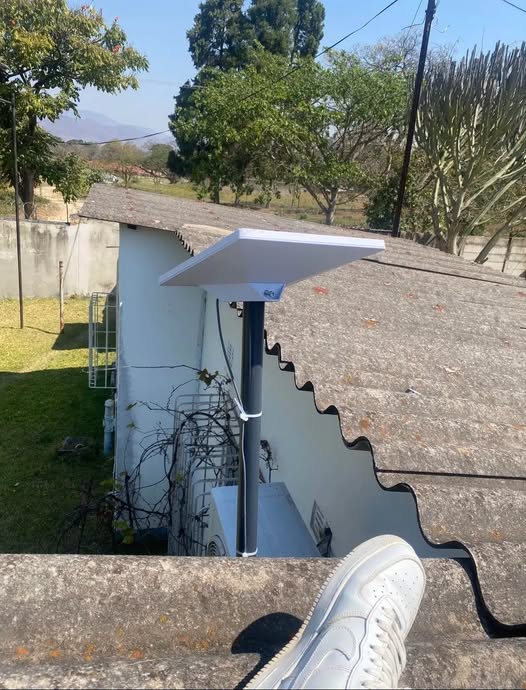
The post carried a photograph of a Starlink dish mounted beside a rural-looking home.
That image says more than the equipment itself.
For decades, internet infrastructure followed familiar inequalities. Densely populated and commercially attractive areas received stronger investment, while remote communities depended on weaker mobile signals or expensive data.
Satellite internet alters part of that equation.
It does not require a fibre cable to reach every household. It still needs electricity, suitable equipment, clear sky visibility and an affordable subscription, but physical distance from an urban telecommunications network is no longer automatically disqualifying.
Starlink says its Mini is designed for basic internet use, has integrated Wi-Fi and can be set up by the user with guidance from its application. The company also advises customers to enter the intended service address to check whether a plan is available at that location.
That helps explain the excitement.
A household that previously bought small mobile-data bundles repeatedly can now compare that spending with the price of a shared home connection.
One commenter calculated that their annual mobile-data spending could buy “mombe six”—six cattle. It was humour, but the frustration underneath it was serious.
Another user said they were sharing a connection with a neighbour, reducing each household’s contribution.
Starlink is therefore entering rural Zimbabwe not merely as another gadget, but as possible household infrastructure.
The price question has no single Facebook answer
The original question asked whether buying online was cheaper than buying from an agent.
Most commenters answered that direct purchasing was cheaper. Some compared an online hardware price of a little over US$200 with agent prices ranging considerably higher.
Others defended agents because they could supply equipment immediately, assist with payment and arrange installation.
Both can be true.
An agent may charge more because the price includes assistance, transport, installation, mounting equipment, cables or profit. A buyer who lacks a suitable payment method may also value having somebody complete the process.
The danger begins when the customer does not know what they are paying for.
A quoted figure may cover only the hardware.
Another may include delivery.
Another may include installation and a pole.
Another may be the initial payment on a financed kit.
Another may include the first month of service.
And another may be tied to an expensive roaming or priority plan because the ordinary residential option is unavailable in that area.
Even the monthly-price debate demonstrated this confusion.
Some commenters insisted the service cost US$30. Others said the final amount was US$35 after an additional charge. Others reported paying US$50, US$65, US$70 or more.
Those people may not necessarily be describing the same product, plan, location or financing arrangement.
Starlink offers different hardware and service plans, and availability can depend on the proposed service address. Pricing and product options can also change. The company’s own support information says customers using financing in Zimbabwe may face plan-change restrictions during the financing term. It also says residential availability can be restricted in areas that have reached capacity.
The safest comparison is therefore not “What does Facebook say Starlink costs?”
It is:
What kit am I buying?
Is it new or previously activated?
Am I purchasing it outright or paying it off?
Which service plan is being activated?
What compulsory charges appear at checkout?
Who controls the account?
What additional installation equipment is included?
What will the total payment be today—and every month afterwards?
The most important purchase may be the account
Several commenters described a serious problem: paying an agent but not receiving control of the Starlink account.
This changes the nature of the transaction.
A person may have the dish on their roof while somebody else controls the email address, password, service plan, billing details and ability to transfer the equipment.
If the agent stops paying an instalment, disappears or has a disagreement with the customer, the connection may be suspended.
If the kit was registered in another customer’s name or under a foreign address, resolving a problem may become complicated.
If the buyer cannot sign in to the official account, they may not even know whether the hardware was purchased outright.
One commenter alleged that an agent accepted the equivalent of a cash purchase but had actually obtained the equipment through instalments. The customer was then expected to continue paying for both service and hardware.
The allegation cannot be independently verified from a comment.
But it identifies an important risk.
The question is not only, “Who sold you the dish?”
It is also, “Whose Starlink is it on the system?”
Customers using an intermediary should insist on documentation showing:
- The kit serial number and activation status
- Whether the equipment is fully paid or financed
- The service plan being supplied
- All recurring charges
- The registered service address
- The account holder’s name and email address
- Whether ownership can be transferred
- Who will provide support if the service stops
A buyer who has paid for the kit should understand whether they will personally control the account.
When an “agent” is simply another customer with internet access
The word “agent” covered several different kinds of seller in the comments.
Some appeared to be established retailers or installers.
Some offered to place an online order on the customer’s behalf.
Others appeared to be individuals using their own payment facilities, referral links or technical knowledge.
These are not necessarily equivalent.
A referral link may produce a genuine promotional benefit. It may also benefit the person distributing it. That does not make it dishonest, but the incentive should be disclosed.
Likewise, helping somebody place an order is a legitimate service. The customer should know the official checkout price and the separate amount being charged for assistance.
The simplest protection is transparency.
If the official cost is US$X and the facilitator charges US$Y for ordering, delivery coordination or installation, the customer can decide whether the convenience is worth it.
If those figures are merged into one unexplained amount, comparison becomes difficult.
Delivery experiences cannot promise your delivery date
The comments produced delivery estimates ranging from three days to more than three weeks.
One person’s experience does not guarantee another’s.
Delivery can be affected by stock availability, payment confirmation, the type of purchase, courier arrangements and the destination.
A person in Chiredzi reported receiving a kit in about six days. Someone else said DHL delivered directly to the home. Rural users explained that parcels could be sent to the nearest town for collection.
Other buyers experienced delays, particularly with financed orders.
These reports are useful as personal experiences. They should not be converted into a universal delivery promise.
Before paying, customers should obtain a written estimate and a tracking process. They should also establish who is responsible if the package is delayed or lost.
“No capacity” does not mean the satellite cannot see your home
Some prospective customers were confused when told that their areas had no capacity.
They understandably asked how a satellite service could run out of space.
Capacity does not necessarily mean that the dish cannot receive a satellite signal at that location.
It concerns how many users the network can serve effectively within an area under a particular plan.
Starlink acknowledges that ordinary residential-plan availability may disappear in sold-out areas. A customer may see a more expensive plan while a cheaper residential option is unavailable.
This helps explain why neighbours can receive different offers, or why an agent may propose a roaming or priority arrangement.
It does not mean every expensive alternative is appropriate.
A buyer should enter the exact intended service location on the official platform and review the options presented there.
Using another address or a foreign registration merely to bypass restrictions may create service and ownership problems later.
“Who will install it?”
Some commenters assumed direct purchasing would leave them with equipment they could not install.
Others described Starlink as largely plug-and-play.
Both positions need qualification.
The Starlink Mini includes integrated Wi-Fi and mounting options, and the company provides setup guidance. But a permanent installation can still involve working at height, routing cables, protecting the power supply, choosing a location with few obstructions and ensuring the mounting arrangement can withstand local weather.
The Facebook photograph itself shows why installation should not be dismissed as nothing.
A dish mounted on a roof edge may require somebody to climb and work near electrical cables. One commenter also asked whether a cable buried to share internet with a neighbour would be safe from lightning.
The confident reply—“safe 100%”—should not be treated as professional advice.
No outdoor electrical or communications installation is automatically free from lightning, surge, water-ingress or physical-damage risks.
People mounting equipment at height or running outdoor cables should use competent installers and appropriate protective measures. The convenience of a self-installing product does not cancel ordinary electrical and fall hazards.
Sharing Starlink is creating tiny community networks
Several users said they shared their connections with neighbours.
One explained that fees collected from connected neighbours now covered the household’s monthly subscription.
This may be one of the story’s most significant developments.
A single connection can become informal infrastructure for several homes. In areas where individual subscriptions remain unaffordable, neighbours may split the cost.
But informal sharing introduces new questions.
How far does the Wi-Fi reach?
Who pays when equipment fails?
What happens when one household consumes most of the bandwidth?
Who controls the password?
Is the arrangement permitted under the applicable service terms?
Does collecting money transform private cost-sharing into a commercial service?
How should outdoor cables be installed safely?
The social-media conversation celebrated the savings without resolving these issues.
That creates an obvious follow-up story: rural Zimbabweans are not only buying satellite internet; some are becoming small, informal internet providers.
Facebook has become the customer-support desk
The most striking feature of the comments was how much practical knowledge circulated between strangers.
People explained virtual payment cards.
They described courier collection.
They compared service plans.
They offered referral links.
They shared installer numbers.
They warned one another about financed equipment, foreign registrations and accounts controlled by sellers.
This is community knowledge doing valuable work.
It is also risky.
Incorrect information travelled beside useful advice. Prices were presented without distinguishing taxes, plans or financing. Delivery experiences became predictions. A lightning question received an absolute assurance. Some people posted or requested personal contact details in a public discussion.
The number of questions suggests that formal information is not reaching customers in the form they need.
Many people do not want a technical support article written for an international audience.
They want somebody to explain, in familiar language:
How much will I pay today?
Mari yemwedzi imarii?
Will it reach kwaGutu?
Can I order it from South Africa for my parents?
Where will the courier leave it?
Does it come with a pole?
Who owns the account?
What happens if the agent disappears?
Until those answers are made easy to find, Facebook comments will continue operating as an unofficial purchasing desk.
Starlink is solving one rural divide while exposing another
Satellite internet may reduce the infrastructure gap between cities and rural communities.
But access still depends on more than signal.
The buyer needs money for equipment and monthly service.
They may need a digital payment method.
They must understand an online purchasing process.
They need an email account they can continue accessing.
They must distinguish official prices from facilitation fees.
They need enough technical confidence to install the equipment or identify a competent installer.
And they must know how to protect themselves when buying through an intermediary.
This is a second digital divide: not simply who can receive the internet, but who can navigate the systems required to obtain it safely.
The Rural Roots post shows enormous appetite for connectivity.
It also shows prospective customers teaching one another what providers, regulators, retailers and consumer organisations should be explaining more clearly.
Starlink has reached kumusha.
The next challenge is ensuring that the person whose roof carries the dish also understands the contract, controls the account and knows exactly what they are paying for.