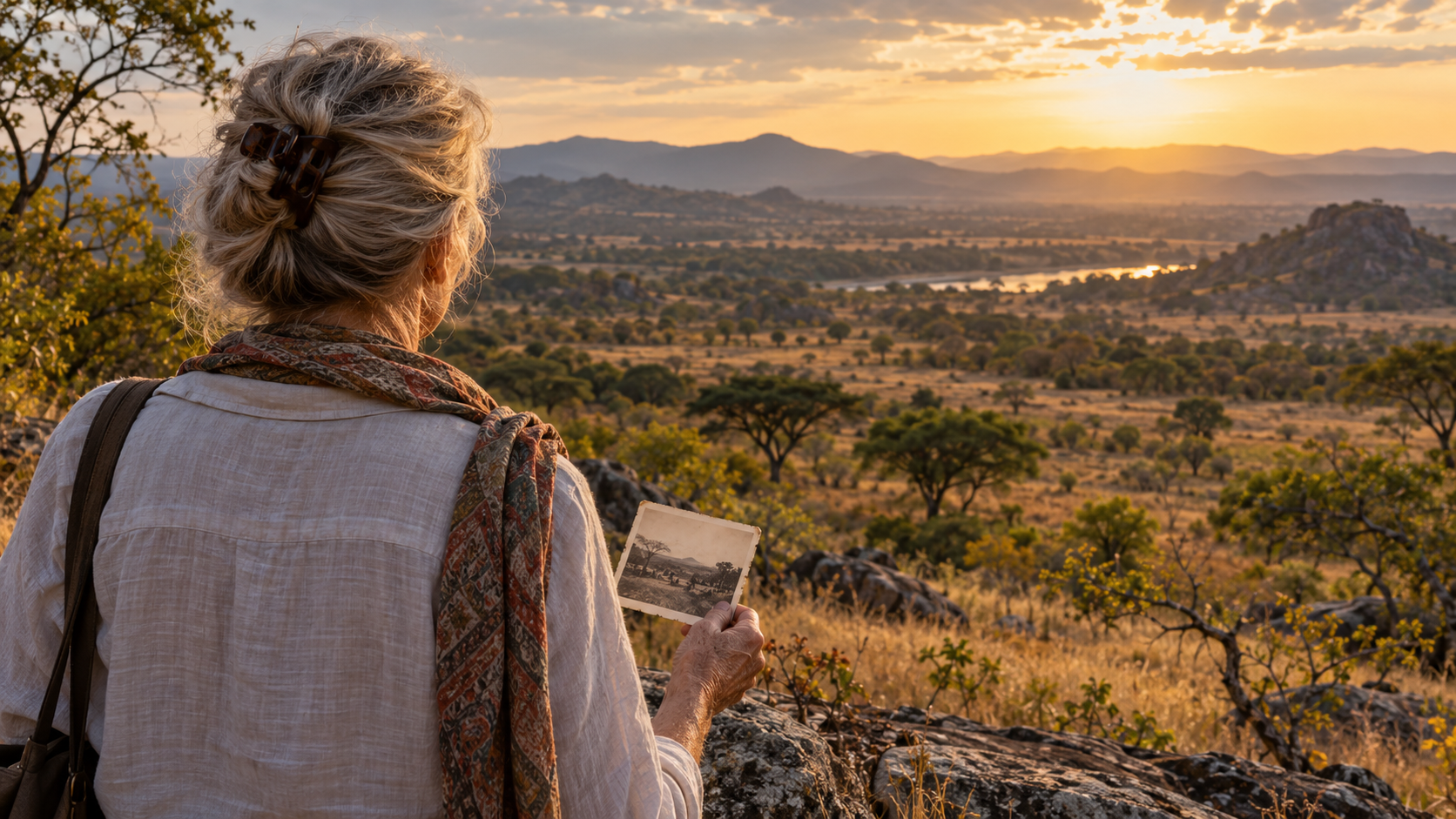
Caron left the country of her birth as a child and has never returned. Her plan to visit Zimbabwe in 2027 prompted excitement, warnings and stories from others who discovered that returning after decades away can be both joyful and unsettling.
Caron Fardoulis was seven years old when she left the country where she was born.
That was more than six decades ago.
She has never been back.
Yet Zimbabwe — or, more precisely, the childhood landscape she remembers from what was then Southern Rhodesia — has apparently never disappeared completely from her imagination.
“I have never been back, but all these years later I still carry so many beautiful memories of the country where my life began,” she wrote in a recent Facebook post.
Now she wants to return.
Fardoulis, who said she was born in 1957, is planning a trip in 2027. Victoria Falls, Hwange National Park, the Matobo Hills and Great Zimbabwe are on her list.
But the destination she seems to be searching for most cannot be found on a normal tourist itinerary.
She wants to find the places connected to her childhood.
“After more than 60 years away, I can only imagine how emotional it will be to stand once again in the country where I was born.”
Her post attracted a flood of encouragement.
“Best wishes! Go and take it all in!” one person wrote.
Another told her: “You will not regret it.”
Zimbabwean commenters welcomed her back, suggested the Eastern Highlands, Kariba and other destinations, and offered help with her trip.
But among all the encouragement was another kind of response.
A warning.
Be careful about going looking for the Zimbabwe you remember.
When the place in your memory no longer exists
Some commenters had already made the journey Fardoulis is contemplating.
Their experiences were complicated.
One person who returned after 22 years away remembered sad moments, but said the happiness of being back overwhelmed them. The sounds of fruit bats and the sight of Zimbabwe’s birds became part of the experience.
Another commenter said she returned in 2025 after leaving in 1981 to settle in Australia.
It was her first trip back.
She described precious memories, tears and finally seeing family again after decades apart.
Another, also living in Australia, had returned after a long absence and described it as an “incredible journey”, while saying Australia was now home but Africa still occupied another emotional place in her life.
But not everyone recommended revisiting the physical places of childhood.
One commenter gave Fardoulis unusually specific advice: enjoy Victoria Falls and Zimbabwe’s tourist destinations, but think carefully before returning to old homes and schools.
His own return had left him wishing he had preserved those places as memories instead.
Another warned that an old house or school might not look anything like the place remembered from childhood.
“Hope it won’t disappoint,” someone else wrote.
And another offered perhaps the simplest preparation:
“Prepare yourself! It’s not as it was.”
That tension ran throughout the discussion.
Go back.
But don’t expect to go backwards in time.
Which Zimbabwe are you returning to?
For somebody who left at seven, memory creates an unusual version of home.
The country changes.
The neighbourhood changes.
Buildings change.
Governments change.
People leave, die, grow older or move elsewhere.
Even the name of the country can change.
Several commenters pointed out that when Fardoulis was born in 1957, the territory was then called Southern Rhodesia, not Zimbabwe. Some expressed nostalgia using the language and identity of Rhodesia; others spoke simply of Zimbabwe or Africa as home.
Those differences matter.
The discussion is not only about tourism. It also reveals how differently people can remember the same country, particularly across generations shaped by colonial Rhodesia, independence, migration and decades of political and economic change.
One commenter who had lived there from 1947 to 1982 remembered decline and expressed strong criticism of the country’s leadership.
Another, who said he returns for several months every year, offered a very different assessment: Zimbabwe has problems, he said, but he also sees improvement.
Others said simply that the people remain friendly, the country remains beautiful and returning is worthwhile.
These experiences cannot easily be reconciled because people are not necessarily returning to the same thing.
Some are looking for a country.
Some are looking for family.
Some are looking for landscapes.
And some may be looking for a childhood that exists most clearly in memory.
“Your heart never leaves Africa”
One phrase kept appearing in different forms throughout the comments.
People who had left Zimbabwe — and neighbouring countries — decades earlier described a connection that had survived migration.
One person wrote that although she had left at 20 and was now 66, her “roots and foundation” remained there.
Another, remembering life in what was then Northern Rhodesia, wrote:
“Your heart never leaves Africa.”
Others talked about remembering the smell of Africa, the arrival of rain after a dry period, Kariba, Victoria Falls, Nyanga and familiar places in Bulawayo.
One woman said she sometimes uses Google Earth simply to look at where she once lived.
These are small details, but perhaps they explain why returning can become so emotionally complicated.
The migrant may have built an entire life somewhere else while preserving fragments of another place: rain on dry ground, particular birds, a school, a road, a house, a landscape.
Decades later, those fragments can remain remarkably vivid.
Perhaps you cannot really return to the same place
Fardoulis ended her post with a simple thought:
“Sometimes a place never really leaves your heart, no matter how many years or how many miles separate you from it.”
The responses suggest the opposite may also be true.
You can leave a place, carry it with you for decades and eventually return.
But the place you return to may not be the one you left.
Perhaps that does not make the journey less worthwhile.
It may simply mean that returning home after 60 years is not about recovering the past.
It is about meeting the place again — as it is now — while discovering what remains of the place you have carried inside you.