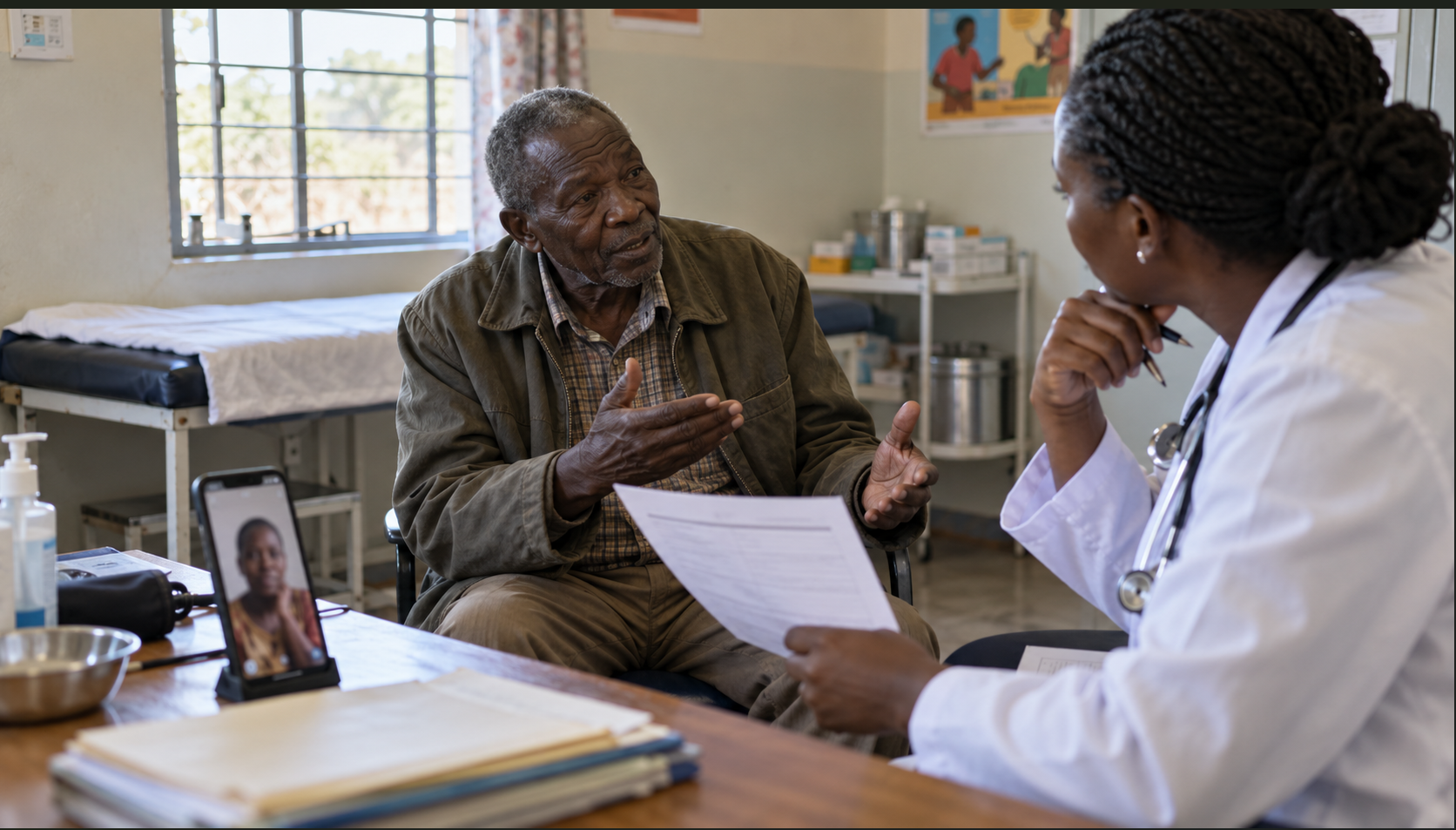
“Sekuru patient: Hanzi nemwana wangu ndiite ma test aya.”
The elderly patient had arrived with instructions from his child abroad: please conduct these particular tests.
Dr Misheck Ruwende asked where the child lived.
“UK.”
Was the child also a doctor?
No, the patient reportedly replied. The child was a nhangirikini—Dr Ruwende’s humorous description of another type of healthcare worker rather than a medical doctor.
The doctor then explained that the illness before him did not require the tests being requested.
His message to “Team UK” was reassuring but pointed: parents and relatives in Zimbabwe were in capable hands. Diaspora children could send money for the tests and other expenses, but Zimbabwean doctors were equally competent to decide which investigations were clinically necessary.
The post attracted hundreds of comments.
Some healthcare professionals recognised the situation immediately. They described relatives calling from Britain, Australia and elsewhere with lists of blood tests, scans and proposed treatments—sometimes before the doctor had taken a history or examined the patient.
Others thought the joke revealed precisely what was wrong with some Zimbabwean doctors.
They accused practitioners of dismissing questions, withholding explanations and interpreting an informed relative as a threat. Several commenters shared personal accounts in which they believed a diagnosis had been delayed, an important test overlooked or a family member treated without adequate communication.
The disagreement initially appeared to be about tests.
It was really about trust.
“Team UK” is frightened
It is easy to laugh at a son or daughter attempting to direct a consultation from thousands of kilometres away.
They may possess limited information. The parent may have described the symptoms badly or omitted important details. The requested test may have come from Google, artificial intelligence, an unrelated patient at work or a conversation with someone who once presented with vaguely similar symptoms.
The relative has not examined the patient. The doctor has.
But distance creates its own form of panic.
A diaspora child may be paying for consultations, medication, transport and laboratory work while having no direct access to the clinician. When they ask the parent what the doctor said, the answer may be painfully incomplete.
“Ndangopiwa mushonga.”
What is the medicine treating?
“I don’t know.”
What diagnosis was given?
“They said it is my back.”
What is wrong with the back?
“I didn’t ask.”
Several commenters described versions of this conversation. Some said elderly parents forgot details. Others suspected that parents downplayed symptoms, misunderstood instructions or returned home and ignored the advice they had received.
The child abroad is then expected to continue financing treatment without understanding what is being treated.
A list of requested tests can become an attempt to regain control.
It may not be medically sophisticated. It may, however, be the response of someone who fears receiving a call saying their parent has deteriorated—and wondering whether they should have pushed harder.
Suggesting a test is not the same as ordering one
The discussion repeatedly collapsed three different behaviours into one.
The first is asking a question:
“Doctor, what do you think is causing these symptoms?”
The second is making a suggestion:
“Could this test help rule out a condition we are worried about?”
The third is issuing an instruction:
“I work in healthcare overseas. Perform these tests and use this treatment.”
Those are not equivalent.
A patient or relative should be able to ask questions, explain concerns, disclose relevant history and suggest something they believe has been missed. That information may help the clinician, particularly when relatives know details the patient has forgotten or withheld.
Good medical decision-making requires a meaningful exchange of information. The UK General Medical Council, for example, describes shared decision-making and informed consent as fundamental to good practice. It says patients should be listened to, given understandable information and supported to participate in decisions about their care.
But participation does not mean that every requested investigation must be performed.
The clinician remains responsible for judging whether a test fits the patient’s symptoms, examination, medical history and likely diagnosis. If the doctor performs an inappropriate investigation merely because somebody on the telephone demanded it, the doctor cannot later escape responsibility by saying, “The child in the UK told me to do it.”
The healthiest version of patient advocacy is therefore not silent obedience or remote command.
It is a conversation in which the family can ask, the doctor can explain and the patient can decide after receiving appropriate guidance.
“We are paying” does not settle the medical question
A recurring response in the comments was straightforward:
If the diaspora relative is paying, why not conduct the tests and give the family peace of mind?
Emotionally, this argument is understandable. Financially, it reflects the reality of many Zimbabwean households. The person sending the money may feel that they should have a say in how it is used.
Clinically, however, payment is not enough.
A test should answer a relevant question. It might help confirm a suspected condition, exclude a reasonable possibility, monitor an existing illness or guide treatment.
Testing without a clear purpose can produce ambiguous or incidental findings. Those results may lead to more testing, greater expense and unnecessary anxiety. Some forms of imaging also expose patients to radiation and must be justified by the diagnostic benefit. The World Health Organization advises that medical imaging should use the lowest exposure necessary to obtain the required information, while screening programmes can produce false-positive results and other unwanted effects even when properly organised.
Zimbabwe’s limited resources add another complication.
One doctor in the discussion pointed out that money spent on irrelevant investigations may no longer be available when the patient needs the test that actually matters. That is especially important when families are paying directly for care and every laboratory request competes with medication, specialist consultation, transport or admission costs.
“Do everything” can sound thorough.
In practice, good diagnosis is not measured by the length of the test list. It is measured by whether the clinician selects and interprets the appropriate investigations in the context of the individual patient.
At the same time, doctors should not use the danger of over-testing as a convenient answer to every family concern.
If a requested test is unnecessary, explaining why may prevent far more conflict than simply saying no.
Zimbabwean doctors are not the same as Zimbabwe’s health system
Some contributors defended Zimbabwean-trained doctors strongly.
They argued that the country produces highly competent clinicians, many of whom now work successfully in Britain, Australia, Canada, South Africa and elsewhere. One commenter described returning to Zimbabwe after clinicians abroad had failed to resolve an illness and receiving effective specialist care at home.
That distinction matters.
Criticising Zimbabwe’s health system is not the same as declaring Zimbabwean doctors incompetent.
A skilled doctor can still be working inside a system affected by staff shortages, restricted access to diagnostics, limited consultation time, equipment failures and patients who cannot afford every recommended investigation.
Conversely, being treated in a wealthy country does not guarantee a correct or timely diagnosis. Diagnostic errors occur in every healthcare system. The World Health Organization says they can involve missed, incorrect, delayed or poorly communicated diagnoses and remain a significant source of preventable harm.
The comments contained examples from both directions.
Some people said Zimbabwean doctors had identified conditions missed abroad. Others described incidents in Zimbabwe in which they believed clinicians had dismissed their concerns, delayed testing or failed to explain treatment.
These personal accounts cannot establish which system is universally superior. They do show why simple reassurance—“your parents are in good hands”—may not persuade everyone.
Trust does not survive on professional titles alone. It is built through competence, communication, records, transparency and the willingness to explain uncertainty.
When “exposure” becomes superiority
Dr Ruwende objected to the way some diaspora Zimbabweans use the word “exposure.”
The suggestion is often that living in Britain or working somewhere within the National Health Service has given the relative knowledge unavailable to professionals in Zimbabwe.
That attitude irritated many commenters.
They described diaspora relatives who used unfamiliar terminology, announced what “they do overseas” and expected local clinicians to follow instructions without considering the resources or protocols available in Zimbabwe.
A person can acquire useful knowledge through work abroad. Nurses, pharmacists, physiotherapists, occupational therapists, carers and other healthcare workers observe patients closely and may recognise concerning changes.
But membership of a healthcare workforce does not make every worker interchangeable with every other profession.
A pharmacist may understand medication in greater depth than a general practitioner in some areas. A physiotherapist may recognise functional changes that others miss. A nurse may spend considerably more time observing the patient than the doctor does. Each contribution matters.
That is not the same as saying that everybody possesses equal competence in diagnosis or in selecting medical investigations.
One commenter offered a useful comparison: searching online about electrical wiring does not make a customer qualified to direct the engineer. The customer can ask, challenge and request an explanation, but fragments of knowledge are not the same as years of professional training.
The reverse is equally true.
A medical degree should not be used to humiliate the person asking the question. Expertise deserves respect, but it must still be communicated.
The parent is disappearing from the story
The most revealing feature of the discussion was how often the patient vanished.
On one side stood the doctor in Zimbabwe.
On the other stood the child abroad who was sending money and demanding answers.
Between them was an elderly parent being spoken about, transported for tests and used as the territory on which professional authority and diaspora responsibility were being contested.
But whose body is it?
The child paying the bill does not automatically become the patient. Unless the parent lacks decision-making capacity or has formally authorised someone to act, the parent remains the person whose consent and preferences matter most.
A capable adult may choose to involve their children extensively. They may ask the doctor to share information with a daughter in Birmingham or a son in Perth. They may also prefer to keep parts of their medical care private.
Family involvement should therefore begin with the patient’s permission.
This is particularly important when relatives request photographs of records, demand access to results or want to join consultations by video. Technology can improve participation, but it does not erase confidentiality or the patient’s autonomy.
The most effective arrangement may be a named family contact chosen by the patient. With consent, that person can receive a clear summary of the diagnosis, tests performed, medication, warning signs and next steps.
That would reduce the endless chain in which the doctor tells the parent, the parent gives an incomplete account to one child and several relatives then telephone with different instructions.
Some of the conflict begins with poor explanations
Doctors in the comments repeatedly said the relative’s approach and tone mattered.
They welcomed respectful questions but resisted condescension, remote instructions and claims that foreign residence automatically made somebody more knowledgeable.
Families made almost the same complaint in reverse.
They said tone mattered when doctors spoke to elderly patients. Some described practitioners who treated adults like children, became irritated by questions or prescribed medication without explaining what it was for.
Both sides were asking for professional respect while accusing the other of withholding it.
One commenter captured the potential solution through a story outside medicine. A technician was approached by a younger worker who proposed a different way of handling equipment the technician had originally installed. Instead of silencing him, the experienced worker allowed him to explain. He did not promise to accept the suggestion, but the younger person left feeling heard and would be more willing to contribute again.
Listening is not surrendering authority.
A doctor can say:
“I understand why you are worried about that condition. Based on the symptoms and examination, it is unlikely because of these reasons. I recommend these investigations first. If they show this result, or if these symptoms develop, we will then consider the test you mentioned.”
That answer respects the concern without pretending every suggestion is clinically sound.
The relative also has responsibilities:
“My parent told me these additional symptoms. Could they affect your assessment? We were wondering about this test, but we would appreciate your explanation of whether it is relevant.”
That is advocacy without attempting to practise medicine over WhatsApp.
Distance has turned medicine into family project management
The post points to a broader diaspora reality.
Children abroad are often no longer present for the daily care of ageing parents, but they remain financially and emotionally responsible. They coordinate appointments, send money, purchase monitoring equipment, interpret messages and call siblings to check whether medication was collected.
They are attempting to manage a serious human responsibility across borders.
Zimbabwean clinicians, meanwhile, are treating the patient who actually arrives—sometimes without complete records, reliable family information or enough resources to investigate every concern.
Both parties possess something the other needs.
The doctor has clinical training, direct examination and responsibility for the treatment plan.
The family may have historical knowledge, financial capacity and information about how the patient behaves outside the consulting room.
The patient has something more fundamental: the right to be heard and involved in decisions about their own body.
The goal should not be to decide whether “Team UK” or “Team Doctors” has won.
It should be to create a reliable communication channel in which questions can be asked without insult, recommendations can be explained without arrogance and clinical decisions can remain grounded in evidence.
Dr Ruwende’s joke worked because Zimbabweans recognised the character immediately: the relative abroad who has already diagnosed Sekuru before the consultation begins.
But the hundreds of replies showed why that character exists.
Behind the instructions may be arrogance.
There may also be grief from a previous loss, distrust formed by a missed diagnosis, frustration with a parent who cannot explain what the doctor said—or the helplessness of loving someone whose care you can finance but cannot personally supervise.
The test being demanded may not be necessary.
The fear behind it still deserves an answer.