A Zimbabwean immigrant reportedly died in the United States with no family nearby, no insurance and no money set aside for his final expenses.
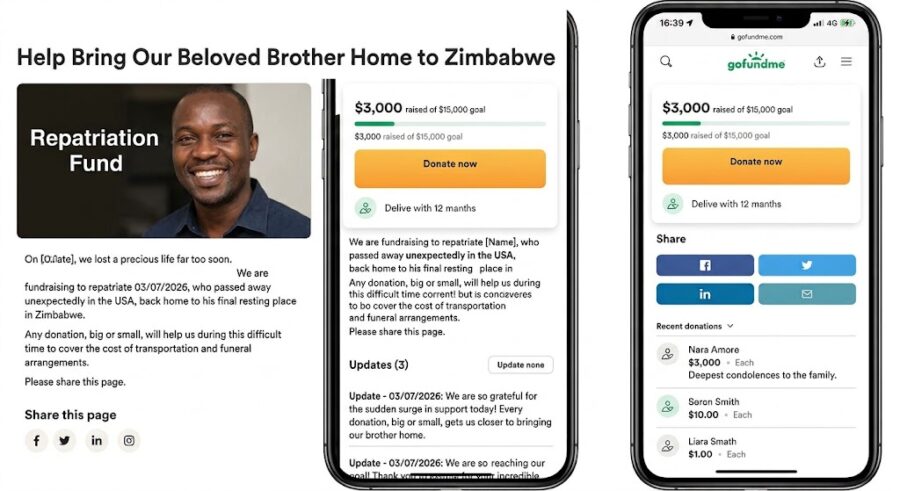
Members of the community created a GoFundMe to help bury him. According to a Facebook post shared in the Zimbabwe-USA Diaspora Community, the response was poor.
The man was eventually laid to rest. But the difficulty of raising the money remained behind as an uncomfortable warning.
“We work hard, support our families back home, pay our bills, and build our lives in America,” the post said, “but we also need to prepare for the unexpected.”
Then came the line around which the entire discussion turned: “Death does not give us an appointment.”
For generations, many Zimbabwean families have treated bereavement as a collective responsibility. When someone dies, relatives contribute money, neighbours bring food, church members organise transport and colleagues collect whatever they can. Even those without formal funeral policies have trusted that, when the moment comes, vanhu vanobatana.
GoFundMe appears to offer a digital version of that old arrangement. Instead of passing around an envelope at work or recording contributions in an exercise book, someone creates a link and shares it through Facebook and WhatsApp.
But a fundraiser is not the same as a plan.
It depends on how many people see it, whether they recognise the deceased, what other appeals they have received that month and how much goodwill remains in a community repeatedly asked to respond to emergencies.
The old chema system was built on relationships and reciprocal obligation. The online version often reaches people who may share a nationality with the deceased but never knew him.
When the donations do not come, grief becomes mixed with panic. Before the family can decide how to mourn, it must first work out what kind of farewell it can afford.
Funeral cover, life insurance—or both?
The Facebook discussion soon moved from the need to prepare into an argument about what preparation should look like.
Some commenters argued that Zimbabweans living in America should purchase American life insurance rather than continue paying for funeral products associated with Zimbabwe. Their reasoning was that life insurance could cover final expenses while also leaving money for dependants, debts, education or a mortgage.
From this perspective, preparing only for the funeral is too narrow. The coffin may be paid for, but what happens to the family the following month?
Others defended funeral policies. They argued that life insurance and funeral cover serve different immediate needs, and that affordability matters. A product designed to release help for burial expenses may be more practical for someone who cannot afford broader cover.
The strongest version of this argument was simple: ideally, have both. But when money is tight, making sure relatives will not have to fund the funeral is still meaningful preparation.
That is the tension beneath the product debate. Life insurance asks what the deceased will leave behind. Funeral cover asks how the family will manage the first crisis. Neither question is trivial.
The right answer may depend on health, age, immigration circumstances, dependants, existing employment benefits, where the person expects to be buried and what a particular policy actually covers.
Yet the comments also showed how quickly public education can begin to resemble a sales pitch.
Several financial practitioners invited people to contact them for policies. The original poster disclosed that he had owned an insurance agency for many years and provided contact details. One sceptical reader asked whether the death was a true story or a marketing strategy designed to generate interest in life insurance.
There is no evidence in the supplied discussion that the incident was invented. But the suspicion matters.
When tragedy becomes the opening for selling a financial product, readers may struggle to distinguish community education from customer acquisition. The advice may still be sound, but transparency becomes essential—particularly when those giving it stand to earn from the decision.
Is it really just about priorities?
Several contributors argued that insurance is affordable if people change their priorities: eat out less, delay the new iPhone or take lunch to work instead of buying food.
That argument speaks to a real contradiction. Some people visibly spend money on entertainment and expensive possessions while leaving their families exposed to a foreseeable financial crisis.
As one commenter observed, people insure their cars and phones but treat life insurance as an unnecessary bill. Another contrasted restaurant meals and polished social-media lifestyles with the absence of anything tangible for those left behind.
But “people can afford it if they stop eating out” can also flatten very different financial realities into one moral judgement.
Some migrants are supporting households in two countries. Others have insecure jobs, debt, medical expenses or immigration costs. Some may have been declined cover, face higher premiums or simply not understand the products being offered. A person who appears comfortable on Facebook may be balancing obligations that are invisible to the community.
One contributor who had lived in America for more than 20 years pushed back against the idea that every uninsured death results from bad priorities. Sometimes, they said, people are simply too poor.
The debate therefore sits between two uncomfortable truths: some people could prepare but postpone it, while others genuinely have very little room left in their budgets.
Calling the first group irresponsible may be fair. Treating the second group as though they merely chose fast food over family protection is less convincing.
Where is home when the journey ends?
The discussion also opened another question: where should a Zimbabwean in America be buried?
One contributor suggested that migrants whose families are established in America should be buried there, while students and people whose families remain in Zimbabwe might prepare for their bodies to be returned home.
The original poster rejected any rule that tried to decide this for others. He said that although his children were in America, he personally wanted to be buried in Zimbabwe.
That disagreement reveals something deeper than funeral costs.
For some migrants, America is now home because their spouses, children and daily lives are there. Burial in America keeps the grave close to the people most likely to visit it.
For others, death completes the journey back to Zimbabwe. They may have lived abroad for decades and still believe their final resting place belongs beside parents, ancestors and the landscape that formed them.
Neither choice can be made intelligently after death if nobody knows what the person wanted.
The cost of burial in America, repatriation to Zimbabwe, local services and family travel can differ substantially. A policy that works for one destination may not meet the costs of another. Preparation therefore requires more than buying something called “cover.” It requires deciding what the cover is supposed to achieve.
That means asking questions many families avoid: Where do you want to be buried? Who should be contacted? Is there a valid beneficiary? Does the family know where the documents are? Will an employer’s group policy remain in place after the job ends? Does the policy pay cash, provide services or cover repatriation?
These conversations feel uncomfortable because they force migrants to imagine an ending while they are still trying to establish a beginning.
But refusing to discuss death does not prevent it. It merely transfers every decision—and every expense—to people already grieving.
The community is not an insurance company
One story shared in the comments captured the old Zimbabwean understanding of funeral preparation with dark humour. A father supposedly used to say that when a son throws himself to the ground crying at a funeral, it may be because he has no money for chema.
Behind the joke is an enduring truth: grief does not cancel financial obligation.
The community will probably continue contributing when someone dies. That generosity is part of how Zimbabweans recognise one another far from home. A funeral appeal is not merely a request for money; it is also a call to affirm that somebody did not live and die unnoticed.
But solidarity becomes strained when it is treated as the only plan.
GoFundMe can help close an unexpected gap. It cannot guarantee that the gap will close. And as more appeals compete for attention, sharing a nationality may no longer be enough to produce the response families expect.
The real choice is not between individual responsibility and community care. A healthy diaspora needs both.
People should make whatever preparation their circumstances reasonably allow. Financial practitioners should explain options honestly, disclose their commercial interests and avoid using shame as a sales technique. Communities should still respond with compassion when a person dies without adequate provision.
The deceased cannot be reduced to a cautionary tale, and poverty should not be treated as a character defect. But neither should repeated emergency fundraising become so normal that nobody asks what could have been arranged earlier.
Perhaps the hardest diaspora question is not whether we will contribute when someone dies.
It is whether we are building a community in which every death automatically becomes everybody else’s financial emergency.