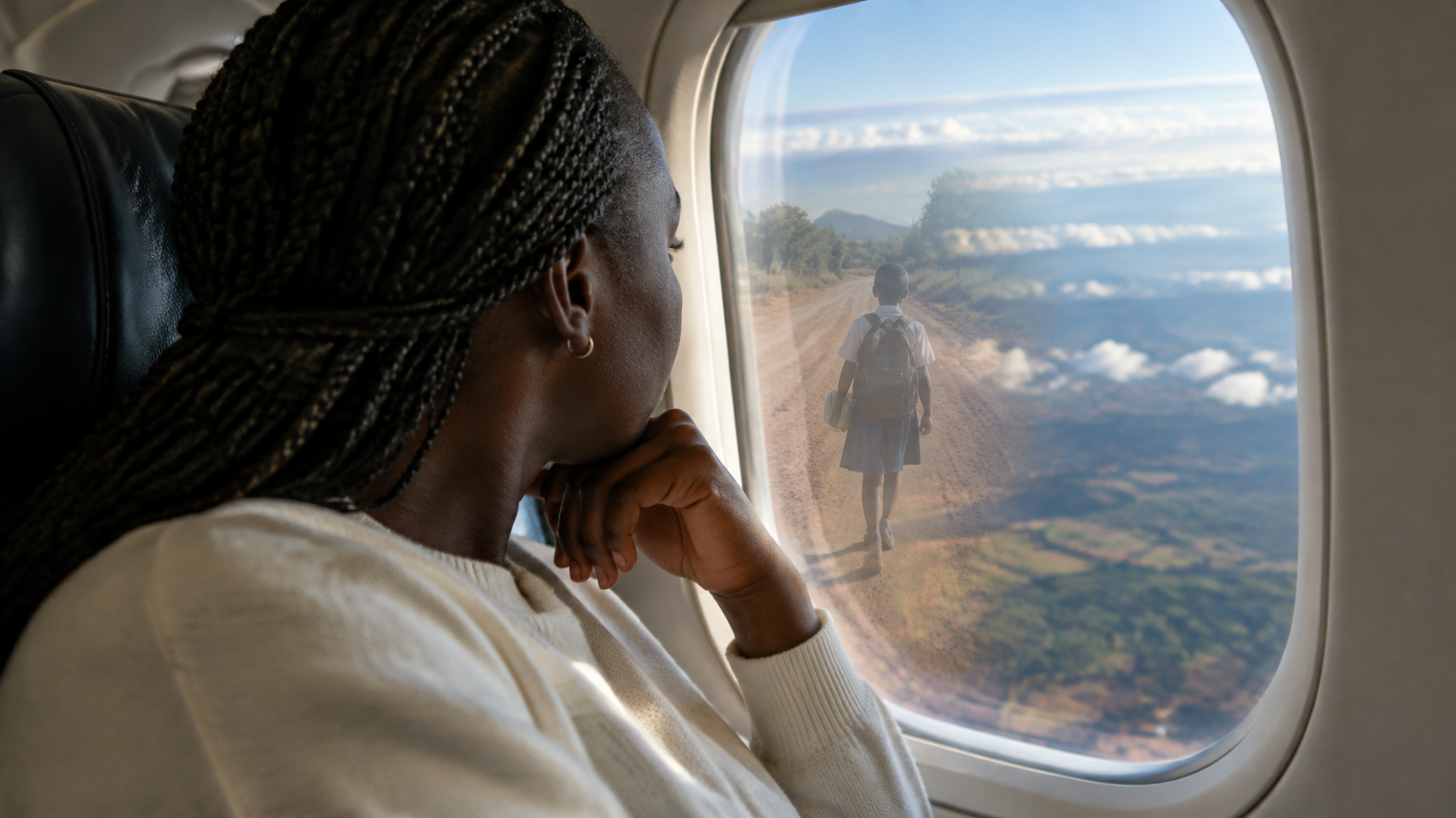
The way Zimbabweans hype flying so…”
Malloy had an observation.
Flying, they wrote, is simply a form of transportation just like boarding a kombi.
An aeroplane carries people from one place to another. For those who travel regularly, the process can become ordinary: airport queues, security checks, boarding announcements, cramped seats and the long wait to collect luggage.
From that perspective, there is nothing remarkable about photographing the boarding pass, recording the walk towards the aircraft or announcing that one is “in the air”.
Then Jess Geraldine responded.
Perhaps the excitement was not really about the aircraft.
Perhaps it was about the life that came before it.
“You grew up with school fees being handled through, ‘We will talk to the headmaster and arrange a payment plan,’” she wrote.
Some people grew up being told they would never become anything.
Others walked 13 kilometres to school.
Some needed “a lot of grace just to barely make it in life”.
For them, Jess argued, flying can be less about the mode of transportation and more about looking back admiringly at how far the Lord has brought them.
That response transformed the conversation.
The argument was no longer about whether an aeroplane and a kombi perform the same basic function.
It became a question about what ordinary things mean when they were once beyond somebody’s imagination.
Technically, it is transportation
Malloy was not entirely wrong.
Commercial flying is transport.
People in countries with established domestic networks may use aircraft as routinely as Zimbabweans use buses between towns. Frequent business travellers can board multiple flights in one month without considering any of them an achievement.
The novelty also disappears.
The person who once photographed every airport sign may eventually complain about delays, baggage limits and the passenger reclining into their space.
Jess acknowledged this.
“When you’ve done it so much it becomes arduous,” she wrote.
Flying can become tiring, inconvenient and repetitive.
But describing its mechanical function does not explain its social meaning.
A wedding ring is technically jewellery.
A graduation gown is technically clothing.
A house key is a small piece of metal.
The emotional value comes from what the object represents.
For some Zimbabweans, a boarding pass operates in the same way.
The photograph is not always about the plane
Social media makes excitement visible.
Someone photographs the suitcase.
Then the passport.
Then the boarding gate.
Then the wing through the window.
Sometimes there is a location tag at the airport before the aircraft has even left.
To a frequent traveller, the performance can appear excessive. Why announce a routine journey as though one has personally invented aviation?
But the photograph may not be saying, “Look at this amazing aeroplane.”
It may be saying:
“I finally reached something I once thought belonged to other people.”
“I can now afford what my family could not afford.”
“The child who used to be sent home over school fees is travelling for work.”
“The person you dismissed is going somewhere.”
“My life did not end where it began.”
The aircraft is visible.
The history behind it is not.
“We will talk to the headmaster”
Jess’s reference to school-fee payment plans will be familiar to many Zimbabweans.
A child is sent home because the fees have not been paid.
A parent visits the school.
There is a promise to pay after the harvest, after a salary arrives or when a relative sends money.
The child returns to class carrying the knowledge that their continued presence depends upon another negotiation.
Other children walk long distances because transport is unavailable or unaffordable.
Some study without electricity.
Some carry books in repurposed bags.
Some are told that university, migration or professional work belongs to children from other families.
These experiences do not automatically produce lifelong shame. They can create resilience, humour and determination.
But they shape the meaning of later milestones.
When a person who once struggled to reach school can afford to travel internationally, the journey compresses years of effort into one photograph.
The distance on the airline ticket may be shorter than the distance travelled in life.
“We were just waiting for our turn”
One of Jess’s most important observations was that some people were “just another person waiting for your turn in life”.
Poverty can create the impression that other people’s lives are moving while yours remains stationary.
You watch classmates leave the country.
You see relatives posting graduations, weddings, cars, homes and holidays.
You congratulate them while wondering whether your own opportunity will ever arrive.
Then something changes.
You secure a job.
A child abroad sends you a ticket.
You receive a scholarship.
You are invited to a conference.
You save enough for a holiday.
You migrate.
You are no longer watching somebody else pass through the departure gate.
It is your name on the ticket.
The excitement may look disproportionate if one examines only the flight. It makes more sense when viewed against the years of waiting.
For some, even the kombi was not ordinary
Comparing flying with boarding a kombi was meant to reduce the aircraft to its basic purpose.
But even that comparison revealed class differences.
One person replying beneath Jess’s post joked that when some Zimbabweans enter a kombi, they behave as though they have scored in a Champions League match.
The humour works because transport itself has never been equally ordinary for everyone.
A child who walks 13 kilometres to school may also celebrate their first regular bus fare.
A household that has never owned a car may gather outside when someone finally purchases one.
A person accustomed to walking may remember the first bicycle differently from somebody who received a vehicle on turning eighteen.
There is no universal threshold at which an experience becomes worthy of celebration.
The threshold depends on where the journey began.
Is posting the moment necessary?
Understanding the excitement does not mean every airport post is profound.
Some posts are displays of status.
Some people deliberately use travel to suggest superiority over those who remain at home.
An airport photograph can become a class signal: I am progressing; you are not.
There are also travellers whose excitement has less to do with overcoming hardship and more to do with gathering attention online.
The replies beneath Malloy’s post reflected this scepticism. Several people rejected the idea that flying deserved special treatment. Others treated the enthusiasm as evidence of poverty or social insecurity.
That interpretation will sometimes be correct.
But we cannot determine somebody’s motivation from a photograph alone.
The same image can represent vanity in one person and gratitude in another.
The responsible response is not to romanticise every airport selfie. It is to avoid assuming that all excitement is ignorance.
Must achievement be hidden to appear mature?
Zimbabweans often have contradictory expectations around success.
People are encouraged to work hard and improve their lives.
But when they celebrate visible progress, they may be accused of showing off.
Buy a car and someone asks why it must appear online.
Build a house and people say real wealth is silent.
Travel and the response becomes: it is only transport.
Graduate and somebody points out that thousands graduated before you.
Get married and someone reminds you that a wedding is not a marriage.
Every achievement can be reduced to its ordinary function.
A car is transport.
A house is shelter.
A degree is paper.
A wedding is one day.
A flight is movement.
But human beings do not live only through function. We attach memory, struggle and hope to material things.
The danger begins when celebration becomes contempt for those who have not achieved the same milestone.
Joy itself is not the offence.
Celebration can also belong to the family
A first flight is rarely an individual story alone.
Behind the passenger may be parents who sold crops to pay school fees.
There may be a sibling who postponed their own plans.
There may be an aunt who provided accommodation in town, a teacher who kept the child in class or a relative abroad who opened the first door.
This is why airport celebrations sometimes involve entire families.
People accompany the traveller to the terminal even when they are not flying.
Photographs are taken at every stage.
Phone calls are made after landing.
The excitement may appear excessive to an outsider, but the traveller is carrying a collective investment.
The flight becomes proof that the sacrifices produced something visible.
The faith inside “thus far”
Jess used religious language: “thus far the Lord has taken you.”
One commenter beneath her response joked that excited passengers behave as though they are singing “Ebenezer”.
The reference is fitting.
In many Zimbabwean households, progress is narrated through faith. Surviving hardship, finding work, migrating or travelling becomes testimony.
The airport post may therefore communicate gratitude as much as achievement.
It says:
“I did not arrive here by my strength alone.”
Not every reader will share the religious interpretation. But understanding the language of gratitude helps explain why the moment can feel larger than transportation.
The aircraft is taking off today.
The testimony began years earlier.
Frequent travellers should remember the first time
Routine is evidence of privilege becoming normal.
That does not make frequent travellers bad people. It means repetition has removed the emotional intensity from an experience.
The person who flies for work every month sees queues and delays.
The first-time traveller sees the inside of a world previously encountered only through television, stories and social-media photographs.
Both experiences are real.
One does not need to imitate the other.
The experienced traveller is allowed to be tired.
The first-time traveller is allowed to be excited.
Jess’s argument was ultimately about generosity.
“I would never look at someone so excited for it and think otherwise, especially if I don’t know their story,” she wrote.
That is the line at the centre of the debate.
We often see the celebration without seeing what was overcome.
Let people mark their distance
Flying does not prove that a person has succeeded in every area of life.
It does not make somebody wealthier, wiser or more important than those who remain on the ground.
A ticket can be bought through debt.
A flight can end in disappointment.
Migration can introduce struggles that the departure photograph does not show.
But none of that makes the first moment meaningless.
Malloy was correct about the destination of the machine: an aircraft is transportation.
Jess was speaking about the passenger.
The passenger may have come from unpaid school fees.
From a 13-kilometre walk.
From people who predicted failure.
From watching others leave while waiting for their own opportunity.
When that person photographs the wing through the window, they may not be celebrating altitude.
They may be measuring distance.
Not the kilometres between Harare and Johannesburg, London or Dubai.
The distance between the life they inherited and the life they once doubted they would reach.
Let them take the photograph.
Tomorrow, flying may become ordinary.
Today, it is Ebenezer.