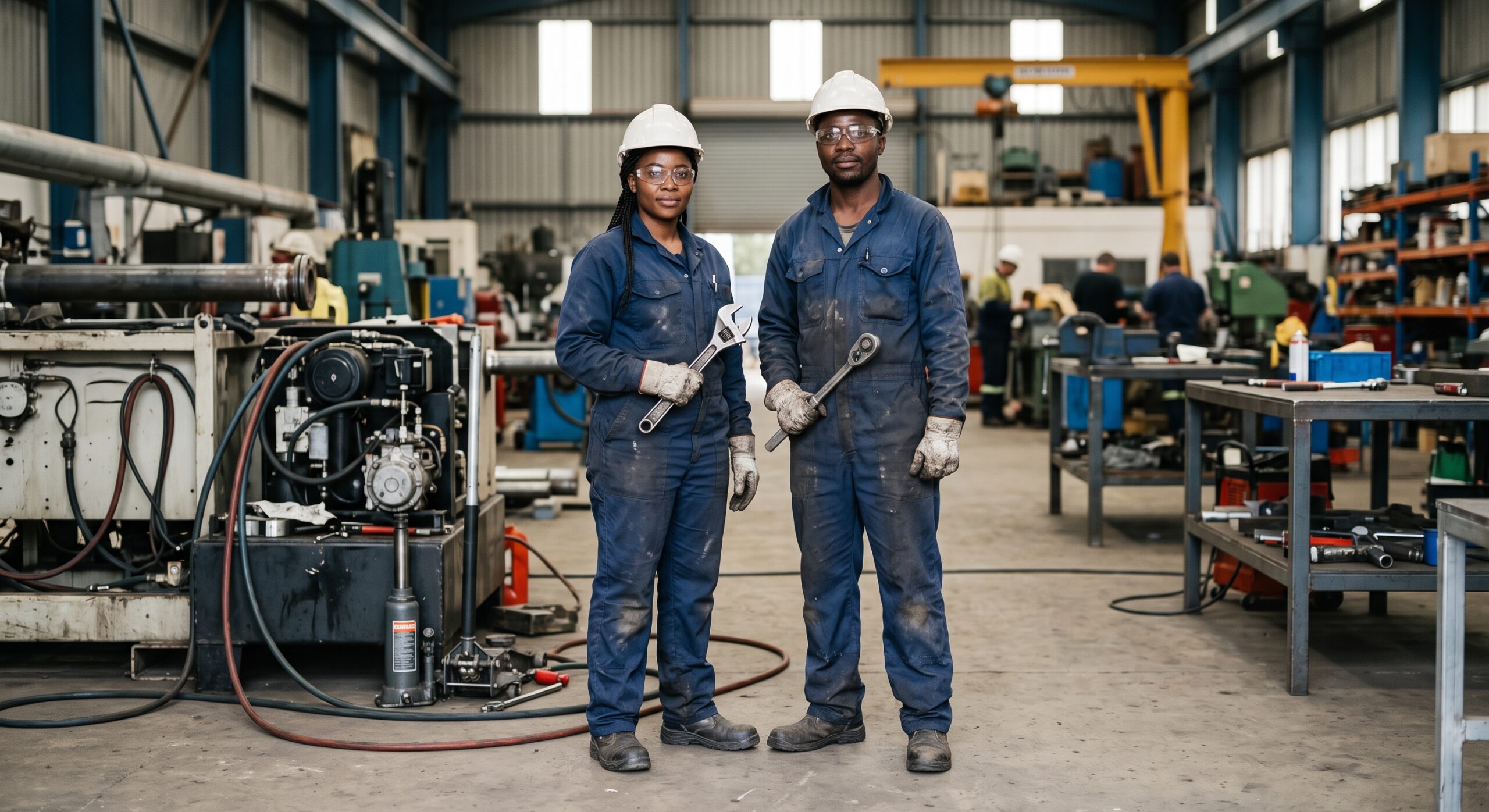
“Vaskana…ikozvino musadadire Vakomana vemaWorksuit, helmet neSafety shoe …ndoovakuendesa kuAustralia”
Girls, this is no longer the time to be too selective.
That was the playful warning in a Facebook post by Tariro Rachel. The men Zimbabwean women should apparently be watching were not the ones arriving in polished suits.
They were the ones wearing worksuits, helmets and safety shoes.
According to the joke, those were the men who might eventually take their partners to Australia. Women should encourage them to begin their skills assessments immediately.
The comments understood the humour.
People tagged partners, nominated electricians, diesel mechanics, plumbers, machinists and fitters, and joked about assembling an entire FIFO team. Some women proudly identified themselves as members of the worksuit community. Others wanted to know why they should marry an artisan when they could qualify for the work themselves.
What began as relationship banter quickly became something more useful: a discussion about how migration changes the social value of work.
In Zimbabwe, the admired career has often been represented by an office, formal clothes and a professional title. In mining economies such as Australia, however, a person who can install, repair, weld, machine or maintain equipment may possess something more immediately valuable than a clean shirt.
A worksuit can become a passport—not literally, and never automatically—but because the skill beneath it may correspond with an occupation used in Australia’s skilled-migration system.
The worksuit has changed status
One commenter described the lesson plainly.
After leaving Zimbabwe, they discovered that “worksuit and skill” were what paid in the diaspora. The old desire for office jobs and formal clothes no longer carried the same weight. They had become comfortable entering shops in dirty workwear and safety shoes without feeling inferior.
That observation goes beyond salary.
Clothing communicates status differently across societies. In one environment, grease on a worksuit may be associated with low-ranking manual labour. In another, it may identify a licensed tradesperson finishing a well-paid shift.
The work itself did not suddenly become more skilled after crossing the border. What changed was the economic system around it: pay, safety standards, bargaining power, labour shortages, certification and respect for technical competence.
This is why the post resonated. It challenged an old social hierarchy in which parents encouraged children towards academic and office careers while treating trades as an option for those who had not succeeded elsewhere.
Yet the people maintaining mines, factories, power systems, vehicles and buildings were never unskilled. Their knowledge was simply undervalued.
Migration has made that value harder to ignore.
“Why wait to be taken?”
The post was addressed to women as dating advice, but women in the comments resisted being cast only as passengers.
One asked why women should wait to be courted by men in trades when they were capable of doing the same work. Another proudly referred to “isu vakadzi vema worksuits”—we women of the worksuits. Someone else said she was preparing to tackle Engineering Drawing.
That was one of the discussion’s most important turns.
The original joke relied on a familiar model: a man acquires the recognised skill, secures the opportunity and later brings his wife. Her migration pathway is connected to his occupation.
But a woman can be the electrician, fitter, machinist, diesel mechanic, welder or engineer whose qualifications open the family’s options.
Encouraging girls into practical trades is not only a slogan about representation. It can give women their own income, bargaining power and mobility. It can also protect families from depending entirely on one person’s career.
The better message may therefore be broader than “marry a man in a worksuit.”
It may be: value the people who have practical skills—and make sure girls have the opportunity to acquire those skills too.
A trade certificate is not a visa
The excitement in the comments also produced considerable confusion.
Some people appeared to treat a trade test, skills assessment, sponsorship and visa as though they were parts of one automatic process. They are not.
Australia uses different skilled and employer-sponsored visa pathways. The occupation, visa subclass, applicant’s age, English ability, work history, assessing authority, state or employer involvement and licensing requirements can all affect the process.
A skills assessment does not itself grant a visa or guarantee employment. It examines whether a person’s qualifications and employment experience meet the relevant Australian standard.
Trades Recognition Australia explains that its Migration Skills Assessment is a documentary process comparing qualifications and employment history with Australian requirements. It also warns that a successful assessment does not award an Australian qualification, occupational registration or licence. Different programs apply to different occupations, countries and visa pathways. Trades Recognition Australia
A sponsor is also not required for every skilled pathway. Australia’s occupation system is used across several different visas, including points-tested, state-nominated and employer-sponsored routes. Each has its own conditions. Australian Department of Home Affairs
That distinction matters because bad information can cost people money.
Someone may possess a Zimbabwean or South African trade qualification and years of experience yet still need documentary evidence, practical assessment, English testing or local licensing. Another person may qualify for a pathway that does not require an employer at the beginning. Someone else may hold an eligible occupation but fail to meet the requirements of the particular visa they selected.
The process starts with identifying the correct occupation and visa pathway—not with selling property or paying whoever promises the fastest route.
How much should someone risk to leave?
One of the sharpest disagreements began when a commenter described a friend who had reportedly sold a residential stand, a vehicle and used all his savings to reach Australia.
To the commenter, the story was a warning. The man had disposed of the assets he already owned so that he could migrate, work and eventually buy back what he had sold.
Others rejected that interpretation.
They argued that the sale may have been a strategic conversion of assets, not evidence of failure. If the migrant could rebuild the same wealth within a few years—and perhaps double it—then the decision might still make financial sense.
Both positions contain a valid concern.
Migration can produce an extraordinary return for someone whose skills are in demand. But the calculation looks different before departure, when the outcome remains uncertain.
Selling a stand and vehicle may fund assessments, English tests, applications, travel and settlement. It may also remove the safety net a person needs if the visa is refused, employment is delayed or the promised opportunity does not exist.
Neither a photograph of a new vehicle nor a story about someone losing everything proves what a typical applicant should expect.
The sensible comparison is personal:
What will the complete process cost?
Which parts are refundable?
Is the job offer genuine?
What income is realistic after tax and living expenses?
What happens if the process fails?
How long would it take to recover the assets being sold?
Migration is not automatically reckless because it is expensive. It is reckless when the applicant cannot explain the pathway, the total exposure and the fallback plan.
“Build businesses at home” is not an answer for everyone
Another disagreement concerned whether skilled Zimbabweans should leave at all.
One commenter argued that people should be encouraged to build businesses locally because the grass abroad was no longer greener.
The response was immediate: not everybody wants to become an entrepreneur.
That reply deserves attention.
“Start a business” is often offered as though self-employment is a universal cure for unemployment and poor wages. But entrepreneurship requires capital, customers, systems, risk tolerance and an operating environment in which effort has a reasonable chance of being rewarded.
A talented machinist may want to machine components, not spend every day finding clients and collecting debts. A brilliant electrician may prefer stable employment to managing workers, quotations, taxes and cash flow.
There is no moral superiority in remaining in Zimbabwe, just as there is no automatic wisdom in leaving.
Some artisans have access to profitable mining and infrastructure work at home. Others face unstable contracts, currency problems, poor equipment or opportunities controlled by connections. Their decisions will not be identical.
The question is not whether Australia is universally better than Zimbabwe.
It is whether a particular worker can convert a particular skill into a safer and more sustainable life in either place.
Skills are valuable, but information is the real protection
The post succeeded because it wrapped a serious subject in humour.
Yes, the person wearing dusty safety boots may have stronger migration prospects than somebody whose career was traditionally considered more prestigious.
Yes, Zimbabwean women should reconsider the idea that technical trades belong only to men.
And yes, an experienced artisan may be able to transform their family’s circumstances through international work.
But a worksuit is not a visa category.
The real asset is the combination beneath it: recognised competence, documented experience, the correct assessment, accurate information, sufficient funds and a legitimate pathway.
Perhaps the social lesson is not that women must quickly marry tradesmen before they disappear to Australia.
It is that Zimbabwe has spent too long looking down on people whose hands keep entire industries operating.
Now that other economies place a higher price on those skills, the worksuit suddenly looks attractive.
The uncomfortable question is why many of us needed Australia to teach us its value.