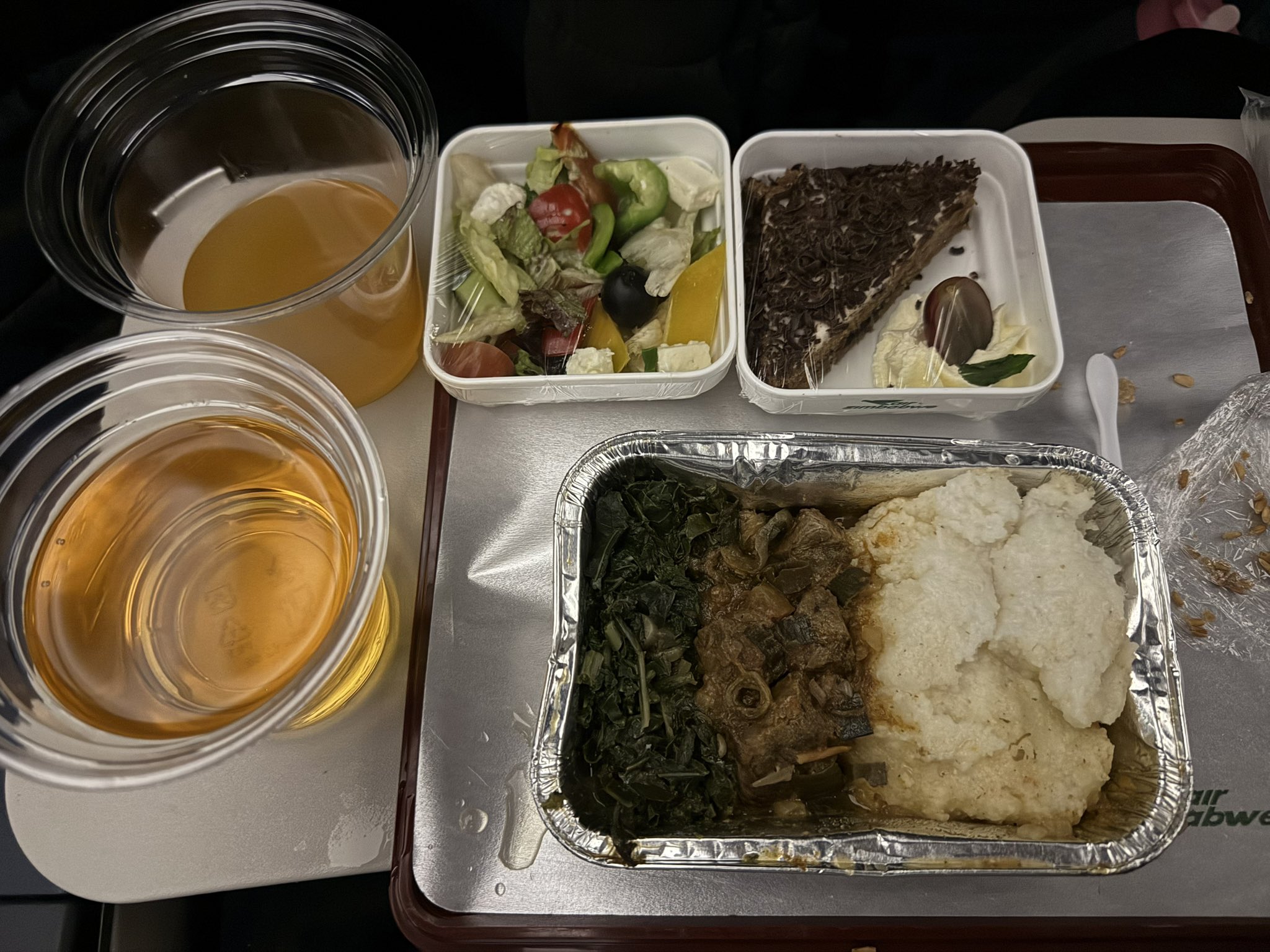
It started with an ordinary travel post. Then Zimbabweans saw the sadza.
John Cole had shared photographs from his Air Zimbabwe journey from Zimbabwe to the United Kingdom. There was the airport photograph, the flight information and, among the images, his in-flight meal.
Air Zimbabwe thanked him for flying with the national carrier.
But in the replies, attention began drifting away from the journey.
“Was the sadza hot?” one person wanted to know.
Another delivered the line that would probably make any airline caterer wince:
“That sadza is fighting for its life.”
Soon the meal had become a conversation of its own.
And when Zimbabwean X personality King Jay picked it up, the jokes became a public challenge to the national airline.
“Are you into brick moulding now?”
King Jay wasn’t criticising Air Zimbabwe from the position of someone who wanted the airline to fail.
Quite the opposite.
He described himself as one of the carrier’s biggest cheerleaders before telling Air Zimbabwe that it could produce better sadza. He joked about “brick moulding”, called for the airline to revisit its kitchen and promised to check back in two weeks.
The replies were merciless.
There were comparisons to bricks, boarding-school meals and mass-produced sadza. One commenter questioned whether the presentation deserved even the original 4/10 assessment.
Another simply appealed to the airline:
“Please respect our national dish.”
But beneath all the tsitsitsitsi and laughing emojis was a surprisingly serious disagreement.
Is the sadza bad—or does it just look bad?
Not everybody thought Air Zimbabwe had committed a culinary crime.
One commenter essentially argued that the sadza itself looked perfectly acceptable — “sadza iro bho” — but conceded that its presentation left something to be desired.
That distinction matters.
Sadza isn’t normally a food designed around airline trays, reheating schedules and tightly controlled portions. At home, it arrives fresh from the pot. Its texture, temperature and consistency are part of the experience.
Put the same food into an aircraft catering system and things become more complicated.
One commenter wondered whether wrapping the sadza in heat-safe material could help it retain moisture. Another pointed out that sadza is particularly difficult to serve because Zimbabweans have strong expectations about portion size and presentation.
And another raised the altitude problem: food simply doesn’t behave — or taste — exactly the same way thousands of metres above the ground.
But perhaps serving sadza is precisely the point
There is another way of looking at the photograph.
Air Zimbabwe could serve passengers something generic.
Instead, a traveller between Zimbabwe and Britain can sit down thousands of metres above Africa and be served sadza and muriwo.
For a national airline, that has cultural value.
The criticism in the thread therefore doesn’t necessarily sound like Zimbabweans saying stop serving sadza.
It may be closer to:
If you’re going to serve our food, serve it in a way we’re proud of.
That is a considerably more interesting challenge.
Because somewhere between airline catering requirements and the expectations of a Zimbabwean who knows exactly what good sadza should look and feel like, Air Zimbabwe has to find a version that works in both worlds.
And judging by this conversation, Zimbabweans are very willing to help with the quality inspection.
King Jay has already promised to return in two weeks.
So perhaps Air Zimbabwe’s kitchen now has a deadline.
The nation will be waiting for the next plate.